ENGLISH
    • 한국어
    • ENGLISH
    • 日本語
    • 中文-繁體

    2026.03.12 Press Release

    NCSOFT Announces Three Core Growth Strategies, Targeting KRW 5 Trillion in Revenue by 2030

    Announced three core growth strategies, targeting KRW 5 trillion in revenue by 2030

    Identified three key growth pillars: Legacy IP advancement, new IP development, and expansion into mobile casual games

    Selected mobile casual as a new growth engine, recognizing its share of more than 30% of the global games market

    NCSOFT today announced its three core growth strategies aimed at ushering in a new era of expansion, targeting KRW 5 trillion in annual revenue by 2030.


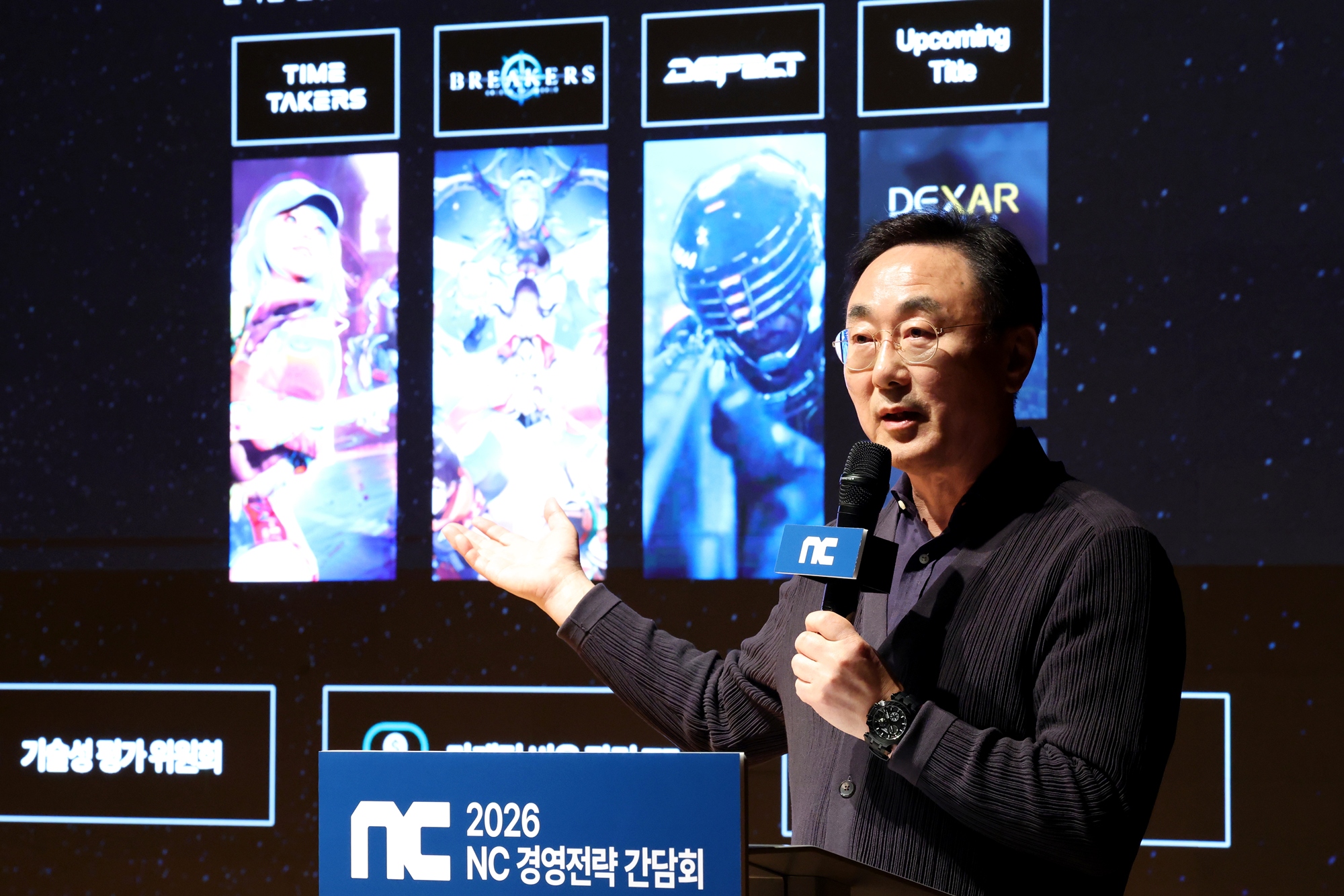
    The announcement was made during the 2026 NCSOFT Corporate Strategy Briefing held at the company’s Pangyo R&D Center in Seongnam, Korea. During the session, Co-CEO Byungmoo Park outlined the company’s growth strategy for 2026 as well as its long-term business direction, while Anel Ceman, Head of the Mobile Casual Center, presented the strategic framework and execution roadmap for NCSOFT’s mobile casual business.

    Advancing Growth Through Three Strategic Pillars: Legacy IP, New IP, and Mobile Casual

    Reflecting on the company’s recent trajectory, Co-CEO Park stated that “The past two years have been dedicated to laying the groundwork for future growth.” Building on this foundation, he introduced three strategic pillars that will drive NCSOFT’s next phase of expansion: enhancing legacy IP, securing new IP, and advancing the mobile casual business.


    NCSOFT will continue to reinforce the core value of its franchises—including Lineage, AION, Guild Wars 2, and Blade & Soul—by further refining live service operations, expanding service regions, and developing new spin-off titles. Through these initiatives, the company aims to strengthen the stable revenue foundation generated by its legacy portfolio.


    In parallel, NCSOFT will pursue a two-track approach to discovering and cultivating new IPs by strengthening internal development capabilities while expanding its publishing business. The company has already secured a pipeline of more than 10 internally developed titles and over six publishing titles spanning a diverse range of genres—including MMORPG, shooter, subculture, and action RPG—with further details to be revealed progressively. By broadening both genre and platform diversity, NCSOFT seeks to expand its reach across generations and global markets.


    Since 2025, the company has also introduced several internal governance systems—including a Game Evaluation Committee, Technology Assessment Committee, and Development Progress Management Task Force—to enhance product quality, strengthen market competitiveness, and ensure disciplined development timelines.


    Looking ahead, NCSOFT has identified mobile casual business as a key new growth engine, recognizing that the segment accounts for more than 30% of the global games market. In 2025, the company established a dedicated Mobile Casual Center and began building a comprehensive ecosystem integrating development, publishing, data analytics, and technology capabilities. According to Co-CEO Park, the combination of NCSOFT’s proven expertise in data analytics and live service operations with talent possessing hands-on execution experience will provide a strong foundation for success in the mobile casual business.

    Building a Predictable and Sustainable Growth Model Toward KRW 5 Trillion in Revenue

    NCSOFT plans to translate the strategic value of its three core growth pillars into measurable financial performance. It aims to achieve KRW 2.5 trillion in revenue and meaningful operating profit in 2026, followed by sustained growth driven by its mid-to-long-term strategy. Ultimately, NCSOFT has set a target of KRW 5 trillion in annual revenue and ROE exceeding 15% by 2030.

    Mobile Casual Strategy: Establishing a Data-Driven, Predictable Growth Model

    Anel Ceman, Head of the Mobile Casual Center, provided a detailed overview of the company’s mobile casual ecosystem and execution strategy.


    NCSOFT’s mobile casual development process will follow a structured five-stage pipeline designed to maximize efficiency and scalability:

    Testing dozens of new game concepts annually

    Rapid production of playable prototypes

    Conducting A/B testing and data analysis with real players

    Scaling user acquisition or discontinuing projects based on key performance indicators

    Applying LiveOps-driven management to successful titles

    Ceman emphasized that data-driven decision-making underpins every stage of this process, enabling a highly predictable and scalable model for both game launches and live operations.


    To support execution, NCSOFT has been systematically building its mobile casual ecosystem by securing globally competitive development studios across Europe, Southeast Asia, and Korea—including Moving Eye, Lihuhu, and Springcomes. In addition, the recent acquisition of platform company JustPlay has provided a critical engine for the ecosystem’s growth. Going forward, NCSOFT plans to further expand this ecosystem through additional studio acquisitions and publishing partnerships.


    All partner studios will be connected to NCSOFT’s centralized data platform, which integrates User Acquisition (UA), ROAS analysis, LiveOps management, creative optimization, and AI-driven tools. This unified platform enables seamless collaboration across multiple studios while maintaining consistent operational efficiency.


    “As our portfolio continues to expand, sustained growth becomes increasingly achievable,” Ceman stated. He added, “NCSOFT has already established the infrastructure necessary to execute a data-driven mobile casual strategy, positioning the company for accelerated growth in the years ahead.”